Canadian Northern Railway Station-1905
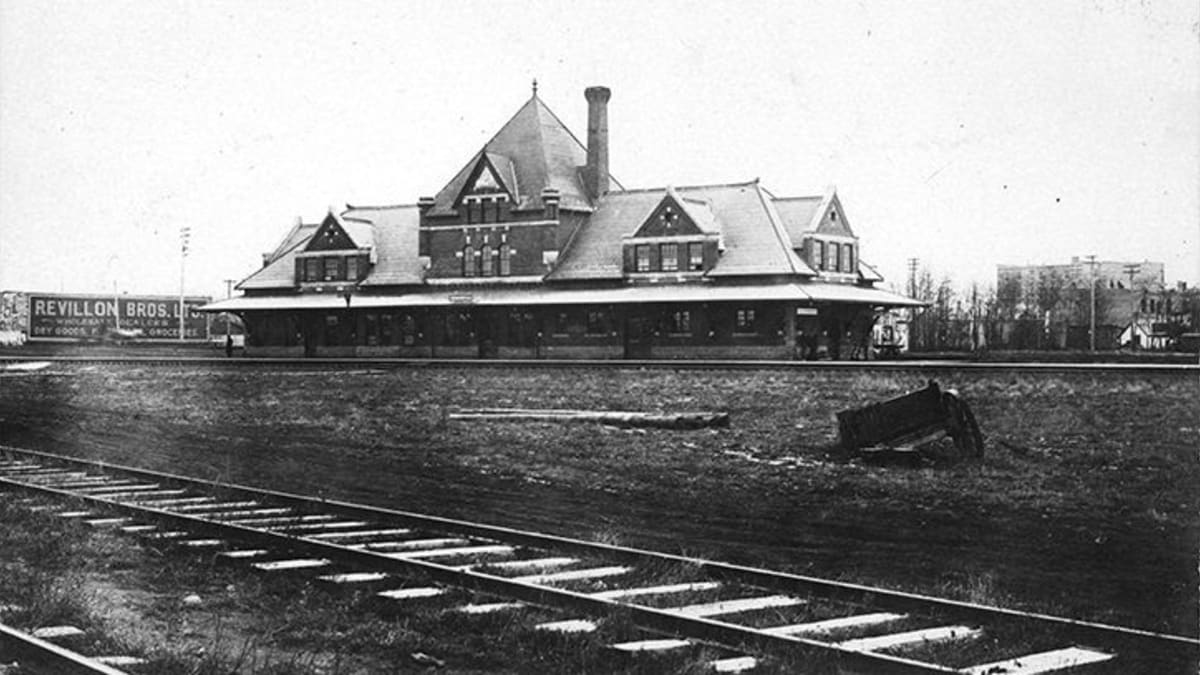
This elegant Prairie railway station heralded the beginning of Edmonton's connection to the world by rail in 1905.
Details
- Historic designation
- Demolished
- Time period
- Urban Settlement: 1870-1904
- People
- Ralph Benjamin Pratt
- Architectural styles
- Prairie
- Character defining elements
- Brick Structure, Bull's Eye Window, Corbelling, Exposed Rafters, Finial, Gable Dormer, Gabled Parapet, Hipped Roof, Keystone, Mansard Roof
Location
About
Standing on the northwest corner of First Street and Mackenzie Avenue, the Canadian Northern Railway (C.No.R.) station was a picturesque Edmonton landmark. The red-brick and Tyndall stone structure stood two-and-one-half storeys tall and measured 138 feet by 33 feet (42 metres by 10 metres). Its steel-sheeted hipped roof was proudly gabled and featured bull's-eye windows with keystone detailing. Entering the building under a veranda with projecting eaves, typical of the Prairie style of architecture, passengers found a ladies' waiting room, general waiting room, ticket offices, baggage room, and dining car department stores. The second floor accommodated offices and the living quarters for the station agent. Although striking, what this station represented overshadowed its architecture.
Edmontonians had been anticipating their own railway since the first train steamed into Strathcona in 1891.When the day finally came, thousands of citizens attended the last spike ceremony on November 24, 1905, which represented the completion of the line and the transcontinental connection between the city and the east. Passengers were coming and going within two weeks, but it took another two months to finally complete the construction of the station. The station was completed at a cost of $35,000 and was heralded as one of the largest stations west of Winnipeg.
Although the completion of the railway, and related buildings allowed for increased settlement of the West, it was experienced differently by First Nations people in the area. More settlement required more land, which led to damaging policy like reserve surrenders, most notable the Papaschase Reserve No. 136.
The C.No.R. shared the station with the Grand Trunk Pacific (G.T.P.) Railway beginning in 1909. Both railways experienced financial troubles however, and within ten years the government took over their operation, forming the Canadian National Railway (C.N.R.). Demand for rail service in Edmonton grew despite the changes, and in 1928 a new C.N.R. station was built. The 1905 station was then used for office space and a bunkhouse for trainmen, before it was demolished to make way for a modern freight terminal building in 1952.