BUILTHERITAGE
Stewarded by the City of Edmonton Archives
  • By Time
  • By Place
  • By Story
⌘K
BUILTHERITAGE
Stewarded by the City of Edmonton Archives

Discover the structures, places, and stories that shaped Edmonton's built environment.

Resources

NewsFAQsLinks

Contact

City of Edmonton Archivesarchives@edmonton.ca780-496-8711

We acknowledge that the land on which Edmonton is built is Treaty Six Territory. We thank the diverse Indigenous Peoples whose footsteps have marked this territory for centuries, such as nêhiyaw (Cree), Dené, Anishinaabe (Saulteaux), Nakota Isga (Nakota Sioux), and Niitsitapi (Blackfoot) peoples. We also acknowledge this as the Métis homeland and the home of one of the largest communities of Inuit south of the 60th parallel. It is a welcoming place for all peoples who come from around the world to share Edmonton as a home. It is important that we not only recognize our shared histories, but also each other's contributions to establishing the built heritage of Edmonton and Area.

© 2026 City of Edmonton Archives
Privacy Policy•Terms of Use•Accessibility
  1. Structures

St. Josaphat Ukrainian Catholic Cathedral

Because of its size, detailingand impressive profile,St. Josaphat's is the best known of Edmonton's Byzantine style churches.

On this record

Connections
14Connections
Stories
1Stories
Photos
2Photos
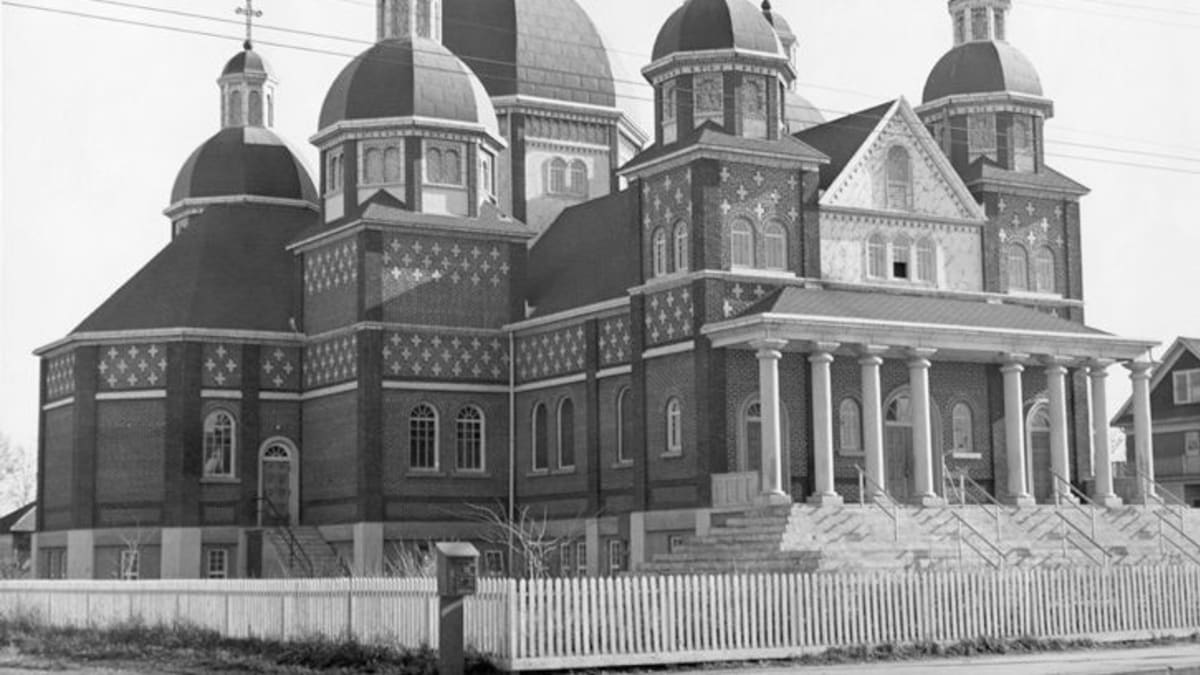
St. Josaphat Ukrainian Catholic Cathedral, exterior view captured in a historical photograph.

On this page

Details

Built
1946
Neighbourhood
Mccauley
Address
10825-97 Street, Edmonton, AB, T5H 2M4
Historic designation
Unknown
Time period
The Post War Years: 1946-1970
People
Philip Ruh
Architectural styles
Byzantine
Character defining elements
Brick Cladding, Brick Structure, Cruciform Plan, Cupola, Dome, Intersecting Gable Roof, Latin Cross, Pediment, Pier or Pillar, Pilaster

Location

About

Until 1902, when the Ukrainian Basilian Fathers arrived in Edmonton, the Ukrainian Catholic population on the prairies was without clergy familiar with their language, culture or liturgy. The Basilians built the original St. Josaphat Church in 1904. However, the parish continued to expand and by the late 1930s the church was deemed too small. Coinciding with the 950-year anniversary of the Christianization of Ukraine, plans were drawn up for an ambitious new building in 1938. St. Josaphat's was designed by Philip Ruh, the architect responsible for over thirty Ukrainian Catholic churches across Canada. Construction was completed in 1947, and St. Josaphat's became known as Ruh's most grandiose example in Alberta.

Built on eighteen city lots in the Byzantine tradition, St. Josaphat Ukrainian Catholic Cathedral is an excellent example of Ukrainian-Canadian church architecture. Constructed of red brick walls with dark brick pilasters and yellow brick crosses, the structure is based on the Ukrainian Baroque nine-part cruciform plan and features a grand entrance with wide stairs and columned portico. The church conveys its role as a sacred space through magnificent interior religious murals, and the sacraments are represented by seven octagonal copper domed cupolas. As the sole Ukrainian Catholic church in Edmonton, St. Josaphat's became the seat of the Bishop when the Ukrainian Edmonton Eparchy was formed in 1948, thus earning it the designation of a cathedral.
Stories

Media